
Telegram / But is it Art?
In the field of art history, the institutional theory of art has long been a popular concept, used to explain how to define art by looking at the boundaries set up around the art world,
The theory is best exemplified by Marcel Duchamp’s (or if it was Elsa von Freytag-Loringhoven or possibly Louise Norton who was the actual artist) readymade sculpture “Fountain”, consisting only of a Bedfordshire urinal. In its usual place – a public restroom – it would have been considered an ordinary urinal, but placed at the exhibition at the Society of Independent Artists in New York, it was transformed into a work of art.
According to this theory, the context of an object determines whether something can be classified as art or not. In extension, the classification is about influence, power, and social class.
Joseph Beuys once declared that “everyone is an artist”, a statement that contradicts the institutional theory of art, as it makes every individual an artist and art something that anyone can create, even without an expensive education or the right gallery connections. Within the contemporary art world, the boundary between artists and non-artists generally follows the organization and hierarchy of class society.
Most people, regardless of their financial or social status, are engaged in some kind of artistic activity: sewing, blacksmithing, carpentry, writing poetry, watercolour painting, or similar. Creativity is an essential part of being human, and art reflects human consciousness. But those who undergo academic training to become artists almost exclusively come from academic homes or the upper middle class. For the working-class, artistic endeavours are often just a hobby, and the art world is for this reason more class-homogeneous than, for example, the music, theatre, film and music industries.
Art made outside of the art world has however long fascinated many of those who are active on the inside. In the early years of the 20th century, it was generally believed that the basic ideas of modern man could be studied in the so-called primitive art around the world, and that these shapes and ideas were still existing deep down in the unconscious of every person.
Concepts of the collective unconscious levels in the psyche are usually associated with Carl Gustav Jung and analytical psychology, but Jung was not unique in this respect. These ideas, with their origins in anthropology, were widely accepted at the turn of the century, and also expressed by many artists during early modernism, often expressed as an interest in what was experienced as primitive.
The first person to write about what we today call “outsider art” (as it’s created outside of the confinements of the art world) was the French cultural writer and doctor Marcel Réja (and whose real name was Paul Gaston Meunier). He was interested in the images of the mentally ill, but also the creations of children and indigenous people.
In 1907, Réja published a book entitled L’Art chez les Fous: Le Dessin, la Prose, la Poésie. In the book, Réja explores creative work by people active outside of the traditional art world. His interest lies more in creative processes, artistic creativity and the origins of image creation than with the individual artists.
The book was followed by two further important works with art theoretical ambitions, Walter Morgenthaler’s Ein Geisteskranker als Künstler: Adolf Wölfi (1921) and Hans Prinzhorn’s Bildnerei der Geisteskranken (1922).
In France, the artist Jean Dubuffet named his collections of outsider art “Art Brut”, consisting largely of images made by people who had been cared for in psychiatric institutions for longer or shorter periods, which makes the concept unusable for anyone who doesn’t share the same background.
In the USA, where interest in such images is great and where there are large collections, in addition to Folk Art, concepts such as Visionary Art, Self-Taught Art, Vernacular Art, or American Primitive have been used.
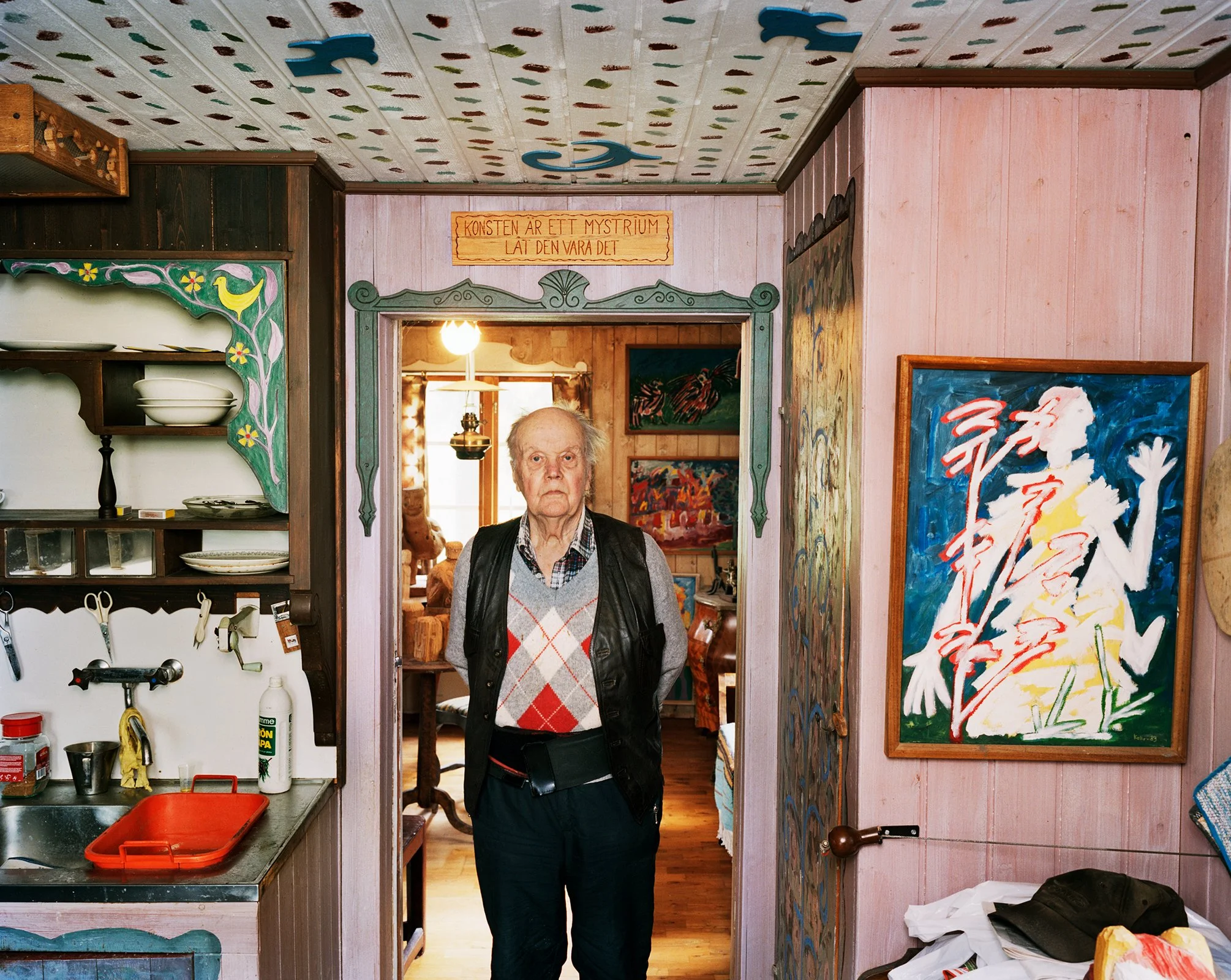
Photo: Lars Tunbjörk
We travelled to Gothenburg on the Swedish west coast to meet Borghild Håkansson, who, together with Staffan Backlund, is the founder of Postfuturistiska Sällskapet (The Postfuturist Society), a cultural association that since 1995 has documented, collected and exhibited art created and existing outside traditional art institutions.
Could you explain the name of your association?
Staffan Backlund It’s an idea based in quantum physics, that time can also go backwards. Arthur Eddington claimed that time does not actually pass. Events do not happen; they’ve been there all along, and we just happen upon them as we move through time. If you think like that, you can relax and surrender, enjoying the ride. If you don’t fight it, it can be a lot of fun.
Borghild Håkansson I agree with that. Because we didn’t plan on having a specific goal, it just happened. And now, it’ll be exciting to see how it develops with our Centre for Other Arts.
How would do you define art?
Staffan Backlund Art exists to express what language can’t reach. There are different ways of looking at outsider art. In Germany it’s seen as pathological, as something created in institutes. In France, it is cerebral and often interpreted by intellectuals. In the US, people wonder what it would cost at auction. So, values shift over time and place.
An example is Jan-Erik Svennberg in the small town of Sala, who travelled to Turkey sometime in the 60s, and was completely knocked out by the architecture. He learned Turkish and painted portraits of all of Turkey’s presidents, and then he built small mosques all over his property, in different sizes. He’s old now, but his mosques haven’t collapsed yet. He has managed to fit a lot of mosques into a very small plot of land!
Borghild Håkansson As a child, I was as far removed from the traditional art world as one can possibly get. We had five books at home, and one was the Bible, and another was about Greenland. But dad used to plough the field with a horse, and I remember how he would come home with half a bucket of fine blue clay that he had found while working. He gave it to me, and I made small figures from it.
How is outsider art viewed by art historians?
Borghild Håkansson I have an idea that if you’re at the top of a hierarchy, you have nothing to lose. The same if you’re at the bottom of the pyramid. But those in the middle – academics and the middle class – they have a lot to lose… If you listen to those who are very established, artists like Jockum Nordström and Karin Mamma Andersson, they often mention outsider art as a source of inspiration.
Staffan Backlund When we did our exhibition at the Gothenburg Art Museum, many visitors would say that it was so fun to see art that you immediately understood, without reading any theoretical texts or contextualisation.
It feels like art is currently drowning in the art world, in these fancy galleries. I know a gallerist based in Bangkok; she works in one of the most prestigious galleries there. I asked her about the latest trends in the art world. ‘Handbags’, she replied. The art and fashion worlds are merging, and the handbag is the status accessory that has gained cult status in both worlds, not least at the major auction houses like Sotheby’s.
Borghild Håkansson We’re talking about money now. But I’ve always said that it’s just as difficult – or just as easy – to recognize quality in established contemporary art as it is in outsider art. Olle Nessle once said that you don’t know what you’re looking for until you see it. And that’s true.
Can anyone develop an understanding of artistic quality?
Staffan Backlund The French poet Arthur Cravan once said that insensitive people are only capable of seeing beauty in beautiful things. Then you have the art critic, whose job is to see a lot of art and then form an opinion based on that knowledge. But is this relevant to others, who haven’t seen as much? There’s a class dimension to this question – a person who sees an Olle Baertling painting and is emotionally affected, and someone who sees a birch painting and is equally affected – the impacts of those experiences are not that different from one another.
Borghild Håkansson In Arendal in Norway, there’s a very nice art gallery called Bomuldsfabriken. They invited us to exhibit in a space downstairs, and upstairs at the same time, two well-established Norwegian artists were exhibiting their works. Two guests started discussing whether our pieces were considered art or not, and the debate became so heated that they almost started fighting! One thought it was art, and the other didn’t.
Is there a common thread in your selection?
Borghild Håkansson What unites those that we collect and exhibit is a sense of curiosity, driven by the desire to see how something turns out. They create art to investigate something, so they probably won’t make five pieces of the same thing, it’s the process, and not the result, that’s important. Like Kello, he said, ‘I’ve had the privilege of never exhibiting, so I can do whatever the hell I want’. That’s freedom. We stumbled across Kello by chance, we were out driving one day and spotted one of his sculptures, outside his cottage in Gullered, from the road. We got out of the car, and he invited us inside, and what we saw really blew our minds. He had carved ornaments in wood and painted patterns on ceilings and walls. His way of making the home a work of art builds on traditions from folk art, but also corresponds to the early modernist desire to transcend the boundaries of academic art and allow creativity and aesthetic experience to take place in everyday life.
Isn’t art fundamentally about curiosity?
Staffan Backlund Art is such a flexible expression, it could encompass everything from cooking to how you make your bed in the morning. Or the art of living. Everything can be art. In Bali, there was once a man who was taught about the European concept of institutional art, and then he was asked if they had any such art on the island. ‘No’, he said, ‘we don’t have art here, we just try to do everything as well as we can’. And that’s enough, I think.
Borghild Håkansson That’s why I do what I do; that’s why I work with these exhibitions, to bring to the surface the value of the process of creation. And to inspire others to create their own art! It’s so terribly simple, but that’s my way of working politically, to work with this art. To encourage people to think and feel, to form opinions and take a stand. Should I go with orange or blue? You can always change your mind later, but you should train yourself to have an opinion.
Staffan Backlund The problem with this kind of art is that it doesn’t cost any money, that’s why it has no cultural status. Many years ago, a columnist for a local newspaper here in Gothenburg contacted a nearby zoo, where there was a chimpanzee who liked to play with paints and brushes. He framed a series of works and exhibited them in a gallery here in town and claimed that it was a French artist who had made them. Everyone went crazy for the art! When he revealed that it was a chimpanzee who had made them, there was a fury. He was sued by the Artists’ Association of Sweden for fraud and the gallery had to close. No one dared to exhibit there anymore. The art world learned nothing from that experiment.
Borghild Håkansson We’ve bought a lot of art at flea markets. Anonymous art. Or accidental art. I think that’s exciting, because then it’s the piece itself that speaks. But I’m very serious about this; I think that creativity is the foundation of society, it’s what ultimately makes us survive.
Staffan Backlund Only in anonymous artworks can the financial aspect of the piece be ignored. But there are also other areas of the art market where there’s no financial value anymore, like in craft products. It’s not just the craft itself that’s forgotten, but even the products themselves. Once, they required a lot of time and attention, but today they’re not appreciated, and they have no value on the market.
Borghild Håkansson I think about how the process of making something, regardless of the result, is completely overlooked today.
Staffan Backlund The act itself is what is truly important, the art objects should be considered as beautiful slag by-products.